Search This Blog

Showing posts with label Walkaround. Show all posts

Sunday, May 21, 2023

Buick Roadmaster Fastback 1942

The 1942 model year was a low-production affair in the United States because the government ordered building of automobiles to halt early in 1942 following the country's entry into World War 2 in December 1941.  Therefore, there aren't very many 1942 American cars around today.

Fortunately, one survivor of an especially interesting type was auctioned by Mecum in 2019, and there are many photos of it available.  It is a Buick Roadmaster Sedanet 2-door fastback.  Only 2,475 1942 Roadmaster C-body Sedanets were made, plus 3,000 Roadmaster and Super Convertible Coupes with the same exclusive fenderline.

Those senior-level Buicks were built on General Motors' new for 1942 C-body that I wrote about here.

Fastback designs were becoming popular in those days because they gave cars a streamlined appearance, and streamlining was expected to be the future of automobile styling.  As it happened, car body shapes became dictated by wind tunnel testing more than 30 years later after the US government imposed fuel economy restrictions.  Classical 1940s fastback styling faded by the early 1950s due to lack of luggage space compared to cars with bustleback trunks.

As hinted above, an interesting styling feature of the Roadmaster Sedanets and Convertible Coupes was the fenderline.  The front fender extended aft until it touched the rear fender.  This was a forecast of near-future fender design by most American carmakers.  All other 1942 Buicks had front fenders that extended only partway across front doors like other GM cars.  Front fenders from most other American carmakers did not extend beyond the front door's forward cutline.  Therefore, this post's subject car was indeed futuristic in its day.

Gallery

The frontal design doesn't seem to match the more dramatic rest of the car.

The roof curve is not as sleek as found in Buick's 1949 fastback redesign, but the trunk carrying capacity here might have been a bit greater.

The rear seems rather heavy from this perspective.

There is a semi- boat-tail shape to the trunk lid area.  The taillight assemblies might have looked better had the round elements been placed towards the body edges.  The setup here has a cross-eyed look.

Those bold, horizontal stripes were eliminated for the next model year: 1946.

Use of rear wheel opening spats was necessary, creating continuation sculpting on the rear fender.

Only a kid in a gas station performing a lubrication job would see this car in something like this way.

Model year 1942 was the first for many years that Buick grilles featured vertical bars.  Buick added vertical bars in the grille for 1939, but that was abandoned for 1940 and 1941 and then brought back for 1942.  The flat bar surfaces create a somewhat weak appearance. Headlight placement at the fender edges rather than closer to the center was GM playing catchup with competitors' designs.

Wednesday, May 17, 2023

Bristol 401 Origin and Walkaround

This post contains speculations regarding the design of the Bristol 401 coupĂ©.  Bristol automobile history mavens are encouraged to correct me in comments if I got things wrong.

In 2013 I briefly wrote about Bristol's sporty 401-403 models.  Since then, more information and photos have appeared on the Internet, so I figure it's time for an update.

The Wikipedia entry for the 401 is here.  Christie's auctioneers had a protoype 401 by Touring Superleggera up for bid and wrote:

"It is a result of the collaboration between the Bristol Aeroplane Co. and Carrozzeria Touring of Milan.  Constructed and designed in Italy, the bodies benefitted from the considerable experience for which the Italian coach building company was renowned.  The engine was built by Bristol to an original BMW design, the licence for this having been obtained in the form of compensation for war damage.  This particular car was built by Touring for the Bristol factory as a prototype and was expected to compete in the 1948 Mille Miglia but was unfortunately not finished in time.  The car was however displayed on the Touring stand at the Geneva Motorshow of 1949.  Bristol had invested a great deal of time and money in this project, matching Touring's light weight "Superleggera" concept with Bristol's own experience in aerodynamics.  Unfortunately the original idea of commissioning Touring to build 200 cars fell through in the end."

It seems that a badly deteriorated Touring 401 was found on a French farm, and its body was recreated by Touring, as mentioned here.

From this point, it seems best to move to the Gallery and discuss images, rather than rely purely on wordage.  Walkaround views are via Gallery Aaldering, a Dutch firm, the subject 1951 Bristol 401 having left-side steering.

Gallery

According to a long-lost Web source, this was supposed to be a 1938 Lancia Aprilia by Touring.  Actually, it was displayed at the 1947 Paris auto show and appears to be the original version of the Bristol 401 body design.

This is the 1947 Touring prototype of the Bristol 401.  It is almost the same as the Lancia in the previous image.  Its grille is the two-nostril BMW style used by Bristol.  The beltline drops closer to the top of the rear fender than on the Lancia and closer than other 401s.  Note the smooth sides of the fenders, something different from other Touring Bristol prototypes.  The front fenderline is more curved than production versions.

Front view of the 1947 prototype, posed with Touring's boss Felice Bianchi Anderloni.  Note the BMW-like grille even at this early stage.

I don't have a source for this photo.  The car's body is by Touring, so it's probably a prototype or possibly an early custom 401.

This is the 401 with the recreated body Touring built.  These cars featured sculpted ridges aft of the wheel openings.

Now for walkaround views of a 1951 production Bristol 401.

The front fenderline is straighter than on the cars in the previous images.

Vision to the rear was limited.

Trunk space was also restricted thanks to the tapered passenger compartment greenhouse.

The greenhouse is tall and the windows are large, a fashion more of the 1960s and 70s than the early 1950s.

Most of the busy detailing is at the front, making a nice contrast with the rest of the car.  All told, a pleasing design.

Sunday, May 7, 2023

Alfa Romeo 2000 Sprint Walkaround 1961


The 1961 Alfa Romeo 2000 Sprint by Bertone pictured in the publicity photo above is of interest because it is one of the first of Georgetto Giugiaro's designs.  It laid the groundwork for his classic Giulia GT.

It needs to be added that both designs' character was inherited from Franco Scaglione's 1954 Alfa Romeo Giulietta Sprint bodied by Bertone.

Photos below of a 1962 2000 Sprint are from Gallery Aaldering, a Dutch seller of classic cars.

Gallery

The overall design is in the spirit of early 1950s Golden Age (to my way of thinking) Italian coachwork.

The car was small enough that a simple fenderline supported by large wheel openings could be used without fear of visual bulk (as found on the 1949 Packard line, for example).

Plenty of glass in the passenger compartment greenhouse due to its height compared to the lower body.

A simple rear end design with the trunk lid lip gently curved so as to avoid a monotonous horizontal effect.


The horizontal upper edge of the rear wheel opening and the sculpting that trails from it are unnecessary: Giugiaro eliminated these on the Giulia GT.  I suspect that little reflector (or running light?) on the front fender was not to Giugiaro's liking, as it added a tiny bit of clutter to this side view.

The front of the car seems a bit heavy looking, but that was largely unavoidable for engineering/functionality reasons.

Quad headlights were expected in those days.  This treatment uses different-diameter lights, adding interest and eliminating the boredom of having four identical large round objects in view.  The chrome strip along the center of the hood seems unnecessary.

Saturday, April 29, 2023

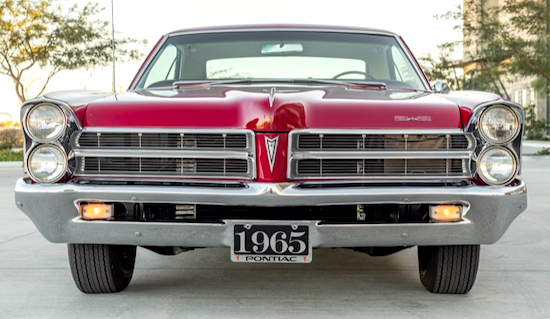
Pontiac Hardtop Coupe Variations 1965

Pontiac styling probably reached its apex during most of the 1960s.   This post focuses on the 1965 model year redesign of 2-door hardtop coupes.

Pontiac's standard size models that year were Catalina, Star Chief, Bonneville, and Grand Prix.  Star Chiefs were only available as four-door sedans and four-door hardtop sedans: the other models included hardtop coupes.  Pontiac's Tempest compact line also had 2-door hardtops, but on a different body platform, so those cars are not treated here..

Gallery

1965 Pontiac Catalina 2+2 hardtop coupe - BaT auction photo
The 2+2 was a performance-enhanced model, so has a few special trim items such as the faux-louvers on the front fender: otherwise, it's typical Catalina 2-door hardtop.  Catalinas and Grand Prix's had a 121.0-inch (3073 mm) wheelbase.  The wheelbase of the Bonneville in the next image is 124.0-inches (3150 mm).

1965 Pontiac Bonneville hardtop coupe - car listed for sale
The Bonneville's extra length takes place abaft of the rear door cutline.  Compare the position of the wheel with the aft point of the rear side window.  Or the aft point of the roof with the wheel below.  The rear fender bulge and length on the Bonneville strike me as being too great, disturbing the proportions of an otherwise attractive design.

1965 Pontiac Grand Prix hardtop coupe - car listed for sale
Model year 1963 saw the appearance of the classic Pontiac Grand Prix.  Its backlight window was a concave, dished-in shape echoed by the aft edge of the wide C-pillar.  That combination was carried over for the 1965 redesign (which wasn't as nice as the '63 original).  One virtue is that the top seems "lighter" than the convex alternatives seen on the Catalina and Bonneville.

Now for a brief walkaround of the Catalina shown in the top image.


Wednesday, April 19, 2023

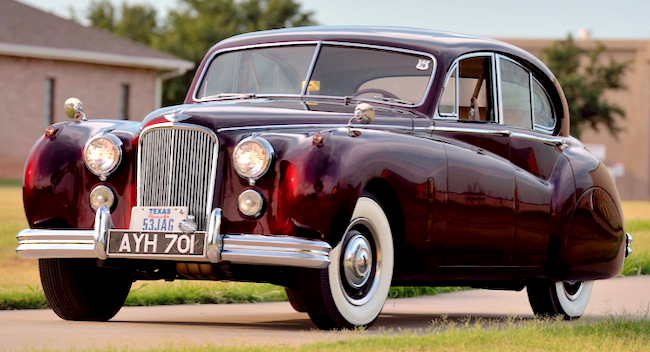
Jaguar Mark VII Walkaround

Most of the Jaguar sedans I saw when I was growing up were Mark VIs and later models with similar bodies.  They were produced 1950-1956.  I wrote about them here.

They were fairly large for non-American cars, having a 120-inch (3048 mm) wheelbase.  American 1950 Fords had 114-inch (2896 mm) wheelbases, Pontiacs (a lower-mid price range make) had 120-inch wheelbases, and Cadillac's best-selling 62 series wheelbase was 126-inches (3200 mm).  So Mark VIIs were well suited for their North American target market.

Since I already discussed the Mark VII, I thought it would be appropriate to do this Walkaroud post.

Gallery

1952 Jaguar Mark VII - Bonhams aution photos
First, two images of a Mark VII with what seems to be its original color.

These views are from slightly different angles than those in the main set below.

1953 Jaguar Mark VII - Mecum auction photos
I'm not sure the paint is a factory color.  That's because the Mark VIIs I recall from years ago had rather bland colors.  That said, I can't rule out the Jaguar factory supplying a custom paint job to a buyer willing to pay extra.

Note the rear wheel covers have a different shape than those on the car in the top photo.  What we see here is similar to the Jaguar XK-120 sports car's.

This telephoto image makes the car seem chubbier than it does in reality.

Note the tiny tail lights and lack of backup lights (though those were rare on American cars around 1950).


A nice, long hood.


A traditional English frontal arrangement, though the headlight are well-blended into the bodywork.

Friday, March 31, 2023

Lamborghini Espada


The best-selling early Lamborghini model was the Espada, 1,227 produced 1968-1978.   It was a Gran Turismo type car with seating for four, though back seating was cramped.

Bodies were made by Bertone, designed by the firm's stylist Marcello Gandini.

Espada's were of the 1970s type, featuring extremely low bodies.  This was a continuation of a long-term trend to ever-lower bodies.  But with the Espada and other cars, the trend seems to have been taken to the point where disadvantages overcame advantages in terms of practical, everyday use (ease of entry and exit, for example).  The wheelbase was 104.3 inches (2,650 mm), and length 186.2 inches (4,730 mm), resulting in noticeable overhang.

Gallery

The first three images appear to be of 1968 Lamborghini Espadas via either Lamborghini or Bertone.

This side view indicates how low the car was.  Measured height is 46.7 inches (1,185 mm) -- for readers familiar with Imperial measurements, that's less than four feet tall.  In comparison, the popular current (as of late 2022) Toyota Camry sedan's height is 56.9 inches (1,840 mm).


Interior view of a 1973 Espada, Gallery Aaldering photo.  Clearly, rear seating is cramped, and getting in and out of that area would be difficult for many adults.

The following walkaround images are of a 1973 Espada via Bring a Trailer auctions.  Frontal design is clean, without much character.  The air vents on the hood are the NACA type seen on aircraft.

The character-less front doesn't matter much because the character of the car and brand is embodied in the rest of it.

Note how the upward curve to the after side window frame visually ties to the top frame of the backlight window -- a nice, professional design touch.

The lower window below the backlight might aid rear visibility a trifle, though rear seats seem to block most of that.

The trunk area is visible in this image.  Some kind of cover seems needed.

The long, horizontal character line carries two air vents near the front wheel opening.  It helps tie the design together and also adds to visually lowering the car by breaking up what little slab-sidedness there is (augmented by the lesser line near the lower edge of the body).

In sum, a nicely styled car aside from its questionable package dimensions.