Search This Blog

Showing posts with label Buick. Show all posts

Sunday, May 21, 2023

Buick Roadmaster Fastback 1942

The 1942 model year was a low-production affair in the United States because the government ordered building of automobiles to halt early in 1942 following the country's entry into World War 2 in December 1941.  Therefore, there aren't very many 1942 American cars around today.

Fortunately, one survivor of an especially interesting type was auctioned by Mecum in 2019, and there are many photos of it available.  It is a Buick Roadmaster Sedanet 2-door fastback.  Only 2,475 1942 Roadmaster C-body Sedanets were made, plus 3,000 Roadmaster and Super Convertible Coupes with the same exclusive fenderline.

Those senior-level Buicks were built on General Motors' new for 1942 C-body that I wrote about here.

Fastback designs were becoming popular in those days because they gave cars a streamlined appearance, and streamlining was expected to be the future of automobile styling.  As it happened, car body shapes became dictated by wind tunnel testing more than 30 years later after the US government imposed fuel economy restrictions.  Classical 1940s fastback styling faded by the early 1950s due to lack of luggage space compared to cars with bustleback trunks.

As hinted above, an interesting styling feature of the Roadmaster Sedanets and Convertible Coupes was the fenderline.  The front fender extended aft until it touched the rear fender.  This was a forecast of near-future fender design by most American carmakers.  All other 1942 Buicks had front fenders that extended only partway across front doors like other GM cars.  Front fenders from most other American carmakers did not extend beyond the front door's forward cutline.  Therefore, this post's subject car was indeed futuristic in its day.

Gallery

The frontal design doesn't seem to match the more dramatic rest of the car.

The roof curve is not as sleek as found in Buick's 1949 fastback redesign, but the trunk carrying capacity here might have been a bit greater.

The rear seems rather heavy from this perspective.

There is a semi- boat-tail shape to the trunk lid area.  The taillight assemblies might have looked better had the round elements been placed towards the body edges.  The setup here has a cross-eyed look.

Those bold, horizontal stripes were eliminated for the next model year: 1946.

Use of rear wheel opening spats was necessary, creating continuation sculpting on the rear fender.

Only a kid in a gas station performing a lubrication job would see this car in something like this way.

Model year 1942 was the first for many years that Buick grilles featured vertical bars.  Buick added vertical bars in the grille for 1939, but that was abandoned for 1940 and 1941 and then brought back for 1942.  The flat bar surfaces create a somewhat weak appearance. Headlight placement at the fender edges rather than closer to the center was GM playing catchup with competitors' designs.

Wednesday, May 3, 2023

Buick 4-Door Hardtop 1967

Sometimes it takes a large canvas to do a subject justice.  Putting it another way, an automobile styling axiom is that it's easier to produce a good design on a large car than on a small one.

Today's example is the 1967 full-size Buick four door hardtop sedan with a 123.0-inch  (3124 mm) wheelbase.  Model names for non-compact/intermediate Buicks were LeSabre, Wildcat and Electra, the latter being the most expensive.  Some background on LeSabres is here -- scroll down to the Third Generation section.

The 1960s represented something of Silver Age (maybe even a Golden one) for General Motors styling.  That was when the peppery Bill Mitchell was Design Vice President.

One of his team's better efforts in those days was the 1967 facelift of the 1965 large-body four-door hardtop sedan.  Yes, those cars were long and large.  Yet graceful, as can be seen below.

Gallery

1968 Buick LeSabre 4-door hardtop - factory image
Nearly identical with '67 models, I include this photo because it does a good job of showing the design.  That downward curving character line echoes Buick's famous 1949-1958 chrome SweepSpear.

1965 Buick Wildcat 4-door hardtop - car listed for sale
Here is the initial design that was facelifted for the '67 model year.  The windshield and door cut lines are the same, but most of the sheetmetal cladding was changed along with the aft section of the passenger compartment top.  General Motors was prosperous then, and could afford such a drastic "freshening."

1967 Buick LeSabre 4-door hardtop - factory photo
The grille is simple, though lacks the traditional Buick vertical chrome bars (which might well have spoiled the design).

1967 Buick LeSabre 4-door hardtop - factory photo
Graceful in side-view, the rear fender area seems a bit heavy in these quarter views.

1967 Buick Electra 4-door hardtop - for sale car
Now for a mini-walkaround.

Electras were longer than LeSabres and Wildcats, having a 126.0-inch (3200 mm) wheelbase.  The passenger compartment top differs from what was shown in the previous 1967-68 photos.  And the effect of the lengthening is a degradation of the design.  The rear overhang seems too long, and the reshaped top is angular enough that the graceful feeling of the LeSabre version is lost.

A trunk made for several sets of golf clubs.

Saturday, April 15, 2023

American Club Sedans in 1930

Names given to automobile body types are not rock-solid.  That's partly because manufacturing techniques change over time, making it more efficient to favor one style while letting another fade away.  Mostly, body type names are the stuff of marketing.  Here, an upscale name might be placed on a lesser design in an effort to increase prestige and stimulate sales.

That said, some names did persist over the decades.  The word "sedan" has been applied to closed, four-door passenger cars that do not have passenger compartment storage capacity such as is found on station wagons and SUVs.  Two-door cars called sedans and not something else slowly became more common during the 1930s, and "two-door sedan" was an established body type name in the USA by the 1950s.  And those body designs then gradually became more coupe-like and the two-door sedan body type slowly faded away.

Today's post deals with the "Club Sedan" body found on some luxury brands during the 1930s. Wikipedia's automobile sedan's entry here says the following regarding the club sedan:

"Produced in the United States from the mid-1920s to the mid-1950s, the name club sedan was used for highly appointed models using the sedan chassis.   Some people describe a club sedan as a two-door vehicle with a body style otherwise identical to the sedan models in the range.  Others describe a club sedan as having either two or four doors and a shorter roof (and therefore less interior space) than the other sedan models in the range."

My sources indicate that 1930s American cars called club sedans were four-door, four-window cars rated as carrying five passengers.  The same type of car was called something different by other carmakers, so the category name was not rigid.  And the use of the term for two-door cars came later: fastback 1946-1950 Packards were labeled club sedans, for instance.

Side views of some club sedans by several car makers are shown below.  Unless noted, they are of for-sale cars.

Gallery

1931 Pierce-Arrow Club Sedan - RM Sotheby's auction photo
That nice, long hood covers a nice, long inline eight cylinder motor.  It's nearly as long as the passenger compartment.  Club sedan passenger compartments tended to be on the short side.  Note the comparatively narrow aft side door, a sometime trait.  A universal club sedan characteristic, as noted in the text above, is that the car is four-window -- leading to a wide C-pillar area, yet another trait.

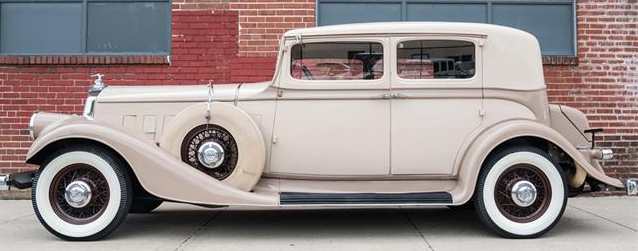
1933 Buick 90 Club Sedan
Club sedans were mostly on luxury or near-luxury brands.  The 90 was the top Buick line.

1933 Packard Twelve Club Sedan
This is a large car, so the rear passenger area is not cramped.

1934 Cadillac V-12 Fleetwood Town Sedan
Cadillac and LaSalle got new bodies for 1934, and this could easily have been called a club sedan, but wasn't.  LaSalle did market a club sedan that year with a different rear side door profile.  Unfortunately, I have no side view of one.

1935 Pierce-Arrow Five-Passenger Club Sedan - Mecum auction photo
Pierce-Arrow got new bodies for 1934.  Here is its '35 club sedan.

1936 Pierce-Arrow Club Sedan - Mecum
And its 1936 version, apparently on a longer wheelbase than the car's in the image above.  Everything abaft of the rear end of the running board is different.

1937 Packard One-Twenty Club Sedan - Barrett-Jackson auction photo
Packard also continued to market club sedans in the late 1930s. This one is from its entry-level inline eight cylinder motor line.  Like the 1935 Pierce-Arrow above, entry to the back passenger seat seems cramped.

1937 Cadillac 75 Five-Passenger Town Sedan
Not a club sedan by name, this Cadillac, like the one shown earlier, has the club sedan look.

1940 Packard One-Twenty Custom Club Sedan - Daniel Schmitt photo
Model year 1940 was Packard's last for four-door club sedans.  This is the entry-level version.

1940 Packard One-Eighty Club Sedan
And this is Packard's top-of-the line club sedan.

Monday, March 20, 2023

Standard General Motors 1965 4-Door Sedans and Hardtops

Even wealthy carmakers -- which General Motors was in 1965 -- choose to economize where justifiable.

Consider the 4-door hardtop sedan body type that GM introduced for the 1955 model year.  Those cars did not share all the passenger compartment greenhouse tooling of the conventional sedans.  That cost extra tooling money.

For the 1965 model year, GM and other American carmakers were now familiar with 4-door hardtop technology, so GM built plenty of them while taking care to minimize additional tooling expenses.  Today's post presents some examples of 4-door hardtops that shared nearly all greenhouse tooling with their 4-door sedan counterparts.

Unless noted, images below are of cars listed for sale.

Gallery

1965 Chevrolet Bel Air 4-door sedan
Standard Chevys had 119 inch (3023 mm) wheelbases.  Bel Airs were mid-range Chevrolets in 1965.

1965 Chevrolet Impala Caprice 4-door hardtop - BaT Auctions photo
Impalas were the Chevrolet prestige line.  Beside the faddish vinyl-covered roof and B-pilars, the main difference with the sedan in the previous image is the hardened profile of the rear-side window opening.

1965 Chevrolet Biscayne 4-door sedan
Now the same from a slightly higher point of view.  Biscayne were entry-level Chevys.

1965 Chevrolet Impala Caprice 4-door hardtop
Compare the door cut lines of the the sedans and hardtops: they are the same.  They only visible sheet-metal difference aside from door pillars on the sedans is that window profile.

1965 Pontiac Star Chief Executive 4-door sedan - Mecum Auction photo
Pontiacs shared the same body platform, though the wheelbase is 124 inches (3150 mm).  Much of that difference seems to be between the aft door cutline and rear wheel opening.

1965 Pontiac Bonneville Vista 4-door hardtop
Same story as for the Chevrolets, though this photos suggests that there might have been a slightly tighter radius on the the roof curve transitioning to the C-pillar.

1965 Buick Wildcat 4-door hardtop
The Wheelbase here was even longer, 126 inches (3,200.4 mm) befitting a more upscale car.  The added length appears to be a stretch in the rear passenger area -- note the longer rear side door.