Search This Blog

Showing posts with label Pontiac. Show all posts

Saturday, April 29, 2023

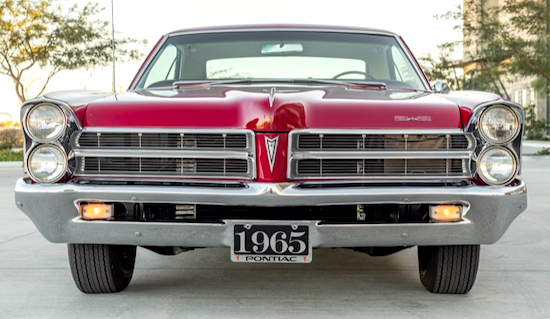
Pontiac Hardtop Coupe Variations 1965

Pontiac styling probably reached its apex during most of the 1960s.   This post focuses on the 1965 model year redesign of 2-door hardtop coupes.

Pontiac's standard size models that year were Catalina, Star Chief, Bonneville, and Grand Prix.  Star Chiefs were only available as four-door sedans and four-door hardtop sedans: the other models included hardtop coupes.  Pontiac's Tempest compact line also had 2-door hardtops, but on a different body platform, so those cars are not treated here..

Gallery

1965 Pontiac Catalina 2+2 hardtop coupe - BaT auction photo
The 2+2 was a performance-enhanced model, so has a few special trim items such as the faux-louvers on the front fender: otherwise, it's typical Catalina 2-door hardtop.  Catalinas and Grand Prix's had a 121.0-inch (3073 mm) wheelbase.  The wheelbase of the Bonneville in the next image is 124.0-inches (3150 mm).

1965 Pontiac Bonneville hardtop coupe - car listed for sale
The Bonneville's extra length takes place abaft of the rear door cutline.  Compare the position of the wheel with the aft point of the rear side window.  Or the aft point of the roof with the wheel below.  The rear fender bulge and length on the Bonneville strike me as being too great, disturbing the proportions of an otherwise attractive design.

1965 Pontiac Grand Prix hardtop coupe - car listed for sale
Model year 1963 saw the appearance of the classic Pontiac Grand Prix.  Its backlight window was a concave, dished-in shape echoed by the aft edge of the wide C-pillar.  That combination was carried over for the 1965 redesign (which wasn't as nice as the '63 original).  One virtue is that the top seems "lighter" than the convex alternatives seen on the Catalina and Bonneville.

Now for a brief walkaround of the Catalina shown in the top image.


Wednesday, April 5, 2023

Three Body Platforms for 1941 Pontiac

By 1940, General Motors had rationalized its system of car body platforms down to three: the A-body, the B-body, and the C-body, in roughly increasing order of size and prestige.  By the early 1950s, most GM brands used only one or perhaps two or those platforms.  But for the 1941 model year, for example, some brands used all three platforms.  That included Pontiac, the subject of this post.

GM's C-body was redesigned for the 1940 model year.  A- and B-bodies were redesigned for 1941.  That meant that they were essentially of the same design generation: none seemed old-fashioned or out-of-place.

So what did Pontiac's managers and stylists do to retain brand identification across those three body platforms?

Let's turn to the Gallery below.  Unless noted, images below are of for-sale cars.

Gallery

1941 Pontiac Custom Torpedo Coupe
Top-of-the-line coupe.  Pontiac brand identification cues include the Silver Streaks on the hood and the echoing ridges on the sides of the fenders.  Also, all Pontiacs shared the same grille design.  Below, four-door sedans from each body type are compared in side-view.

1941 Pontiac De Luxe Torpedo Four-Door Sedan
Here is the new A-body.  Four-door sedans had six-window passenger compartment greenhouses and notch-back trunks.

1941 Pontiac Streamliner Torpedo Four-Door Sedan - photo via Hemings
The new for 'GM 41 B-body sedans were all fastbacks.  Four-door sedans were six-window.  The carryover identification features are the fenders with those ridges/grooves.  The front fender appears to be the same as that of the A-body, above.  But the rear fender is slightly longer.  The hood cutline differs.

1941 Pontiac Custom Torpedo Four-Door Sedan
The C-body Pontiac sedan's front fender and hood cutline seem to be the same as those on the A-body.  Ditto the rear fender.  GM's C-body four-door sedans were four-window types and the trunk areas were bustlebacks, like A-body cars.

Monday, March 20, 2023

Standard General Motors 1965 4-Door Sedans and Hardtops

Even wealthy carmakers -- which General Motors was in 1965 -- choose to economize where justifiable.

Consider the 4-door hardtop sedan body type that GM introduced for the 1955 model year.  Those cars did not share all the passenger compartment greenhouse tooling of the conventional sedans.  That cost extra tooling money.

For the 1965 model year, GM and other American carmakers were now familiar with 4-door hardtop technology, so GM built plenty of them while taking care to minimize additional tooling expenses.  Today's post presents some examples of 4-door hardtops that shared nearly all greenhouse tooling with their 4-door sedan counterparts.

Unless noted, images below are of cars listed for sale.

Gallery

1965 Chevrolet Bel Air 4-door sedan
Standard Chevys had 119 inch (3023 mm) wheelbases.  Bel Airs were mid-range Chevrolets in 1965.

1965 Chevrolet Impala Caprice 4-door hardtop - BaT Auctions photo
Impalas were the Chevrolet prestige line.  Beside the faddish vinyl-covered roof and B-pilars, the main difference with the sedan in the previous image is the hardened profile of the rear-side window opening.

1965 Chevrolet Biscayne 4-door sedan
Now the same from a slightly higher point of view.  Biscayne were entry-level Chevys.

1965 Chevrolet Impala Caprice 4-door hardtop
Compare the door cut lines of the the sedans and hardtops: they are the same.  They only visible sheet-metal difference aside from door pillars on the sedans is that window profile.

1965 Pontiac Star Chief Executive 4-door sedan - Mecum Auction photo
Pontiacs shared the same body platform, though the wheelbase is 124 inches (3150 mm).  Much of that difference seems to be between the aft door cutline and rear wheel opening.

1965 Pontiac Bonneville Vista 4-door hardtop
Same story as for the Chevrolets, though this photos suggests that there might have been a slightly tighter radius on the the roof curve transitioning to the C-pillar.

1965 Buick Wildcat 4-door hardtop
The Wheelbase here was even longer, 126 inches (3,200.4 mm) befitting a more upscale car.  The added length appears to be a stretch in the rear passenger area -- note the longer rear side door.