Search This Blog

Saturday, April 29, 2023

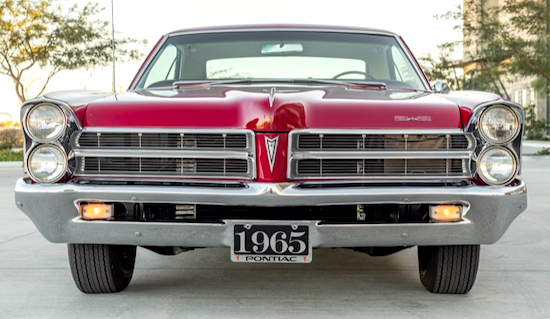
Pontiac Hardtop Coupe Variations 1965

Pontiac styling probably reached its apex during most of the 1960s.   This post focuses on the 1965 model year redesign of 2-door hardtop coupes.

Pontiac's standard size models that year were Catalina, Star Chief, Bonneville, and Grand Prix.  Star Chiefs were only available as four-door sedans and four-door hardtop sedans: the other models included hardtop coupes.  Pontiac's Tempest compact line also had 2-door hardtops, but on a different body platform, so those cars are not treated here..

Gallery

1965 Pontiac Catalina 2+2 hardtop coupe - BaT auction photo
The 2+2 was a performance-enhanced model, so has a few special trim items such as the faux-louvers on the front fender: otherwise, it's typical Catalina 2-door hardtop.  Catalinas and Grand Prix's had a 121.0-inch (3073 mm) wheelbase.  The wheelbase of the Bonneville in the next image is 124.0-inches (3150 mm).

1965 Pontiac Bonneville hardtop coupe - car listed for sale
The Bonneville's extra length takes place abaft of the rear door cutline.  Compare the position of the wheel with the aft point of the rear side window.  Or the aft point of the roof with the wheel below.  The rear fender bulge and length on the Bonneville strike me as being too great, disturbing the proportions of an otherwise attractive design.

1965 Pontiac Grand Prix hardtop coupe - car listed for sale
Model year 1963 saw the appearance of the classic Pontiac Grand Prix.  Its backlight window was a concave, dished-in shape echoed by the aft edge of the wide C-pillar.  That combination was carried over for the 1965 redesign (which wasn't as nice as the '63 original).  One virtue is that the top seems "lighter" than the convex alternatives seen on the Catalina and Bonneville.

Now for a brief walkaround of the Catalina shown in the top image.


Sunday, April 23, 2023

Lucid Air Luxury Electric Car

New for the 2022 model year, the Lucid Air is interesting from a design standpoint.  That's because it is a luxury or perhaps semi-luxury car that needs to appear suitable for that price range.  And it has an electric power train, which imposes the problem of not needing a front air intake, a design feature most buyers are conditioned to expect to find.  Most important, the new brand's visual characteristics trademark needs to be established.  That's a tall order for a styling director

In Lucid's case, the stylist is Derek Jenkins, a man with a good deal of automobile experience plus training at the Art Center College of Design in Pasadena, California.

Images below are factory-sourced.

Gallery

The front features a strong horizontal sweep that's a variation on a current styling chiché.  It differs in that it's narrow.  I'm not sure about what appears to be a chin-level air intake: is it functional?  Note that its shape and color are echoed along the bottom of the car's side.

Side sculpting is typical of current cars.  The car's profile is interesting due to the long, low, six-window passenger compartment greenhouse. Also the short "hood."  What we see is something like 1990s Chrysler Corporation "cab forward" proportions.


Unlike many current cars with two-tone paint schemes, that of the Lucid Air works well.  In fact, I find it a rare instance where two-toning looks better than single-tone paint.

This light-colored car shows off cut lines as well as the flowing dark areas noted earlier.  The flow is repeated at the rear of the car.  This is clever and unique -- especially the flow transitions by the wheel wells.

Front end cut lines.

Overhead view.  Hood sculpting adds interest, and vaguely reminds me of hood sculpting on pre-1960 Vauxhalls.

The greenhouse is low compared to the lower body height, furthering a racy appearance.  That low height reduces potential visual bulk for that lengthy feature.  I include this image because I recently saw a similar Lucid Air while driving, thus inspiring this post.

So did Jenkins succeed?  Yes, the car strikes me as looking fairly luxurious, thanks to the low greenhouse.  There is enough going on at the front that the lack of a grille isn't too obvious.  The brand identification matter is more difficult to evaluate.  In part, that's because it would be necessary to view follow-on designs to find out which features were carried over (keep in mind that Lucid could easily become a market failure).  The horizontal sweeps for the front and rear head- and tail-light assemblies are too cliché-like to serve that purpose.  The interesting flowing details along the lower edges of the car have potential, but their location makes them easy to ignore when casually viewed.  The low, six-window greenhouse with two-toning has the most potential, but also might not be enough.  A distinctive grille design would help the most, but that's not likely to happen.

Wednesday, April 19, 2023

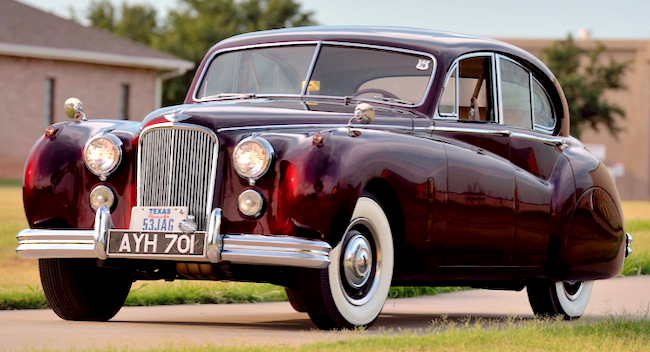
Jaguar Mark VII Walkaround

Most of the Jaguar sedans I saw when I was growing up were Mark VIs and later models with similar bodies.  They were produced 1950-1956.  I wrote about them here.

They were fairly large for non-American cars, having a 120-inch (3048 mm) wheelbase.  American 1950 Fords had 114-inch (2896 mm) wheelbases, Pontiacs (a lower-mid price range make) had 120-inch wheelbases, and Cadillac's best-selling 62 series wheelbase was 126-inches (3200 mm).  So Mark VIIs were well suited for their North American target market.

Since I already discussed the Mark VII, I thought it would be appropriate to do this Walkaroud post.

Gallery

1952 Jaguar Mark VII - Bonhams aution photos
First, two images of a Mark VII with what seems to be its original color.

These views are from slightly different angles than those in the main set below.

1953 Jaguar Mark VII - Mecum auction photos
I'm not sure the paint is a factory color.  That's because the Mark VIIs I recall from years ago had rather bland colors.  That said, I can't rule out the Jaguar factory supplying a custom paint job to a buyer willing to pay extra.

Note the rear wheel covers have a different shape than those on the car in the top photo.  What we see here is similar to the Jaguar XK-120 sports car's.

This telephoto image makes the car seem chubbier than it does in reality.

Note the tiny tail lights and lack of backup lights (though those were rare on American cars around 1950).


A nice, long hood.


A traditional English frontal arrangement, though the headlight are well-blended into the bodywork.

Saturday, April 15, 2023

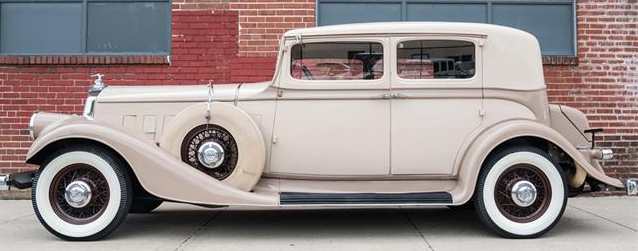
American Club Sedans in 1930

Names given to automobile body types are not rock-solid.  That's partly because manufacturing techniques change over time, making it more efficient to favor one style while letting another fade away.  Mostly, body type names are the stuff of marketing.  Here, an upscale name might be placed on a lesser design in an effort to increase prestige and stimulate sales.

That said, some names did persist over the decades.  The word "sedan" has been applied to closed, four-door passenger cars that do not have passenger compartment storage capacity such as is found on station wagons and SUVs.  Two-door cars called sedans and not something else slowly became more common during the 1930s, and "two-door sedan" was an established body type name in the USA by the 1950s.  And those body designs then gradually became more coupe-like and the two-door sedan body type slowly faded away.

Today's post deals with the "Club Sedan" body found on some luxury brands during the 1930s. Wikipedia's automobile sedan's entry here says the following regarding the club sedan:

"Produced in the United States from the mid-1920s to the mid-1950s, the name club sedan was used for highly appointed models using the sedan chassis.   Some people describe a club sedan as a two-door vehicle with a body style otherwise identical to the sedan models in the range.  Others describe a club sedan as having either two or four doors and a shorter roof (and therefore less interior space) than the other sedan models in the range."

My sources indicate that 1930s American cars called club sedans were four-door, four-window cars rated as carrying five passengers.  The same type of car was called something different by other carmakers, so the category name was not rigid.  And the use of the term for two-door cars came later: fastback 1946-1950 Packards were labeled club sedans, for instance.

Side views of some club sedans by several car makers are shown below.  Unless noted, they are of for-sale cars.

Gallery

1931 Pierce-Arrow Club Sedan - RM Sotheby's auction photo
That nice, long hood covers a nice, long inline eight cylinder motor.  It's nearly as long as the passenger compartment.  Club sedan passenger compartments tended to be on the short side.  Note the comparatively narrow aft side door, a sometime trait.  A universal club sedan characteristic, as noted in the text above, is that the car is four-window -- leading to a wide C-pillar area, yet another trait.

1933 Buick 90 Club Sedan
Club sedans were mostly on luxury or near-luxury brands.  The 90 was the top Buick line.

1933 Packard Twelve Club Sedan
This is a large car, so the rear passenger area is not cramped.

1934 Cadillac V-12 Fleetwood Town Sedan
Cadillac and LaSalle got new bodies for 1934, and this could easily have been called a club sedan, but wasn't.  LaSalle did market a club sedan that year with a different rear side door profile.  Unfortunately, I have no side view of one.

1935 Pierce-Arrow Five-Passenger Club Sedan - Mecum auction photo
Pierce-Arrow got new bodies for 1934.  Here is its '35 club sedan.

1936 Pierce-Arrow Club Sedan - Mecum
And its 1936 version, apparently on a longer wheelbase than the car's in the image above.  Everything abaft of the rear end of the running board is different.

1937 Packard One-Twenty Club Sedan - Barrett-Jackson auction photo
Packard also continued to market club sedans in the late 1930s. This one is from its entry-level inline eight cylinder motor line.  Like the 1935 Pierce-Arrow above, entry to the back passenger seat seems cramped.

1937 Cadillac 75 Five-Passenger Town Sedan
Not a club sedan by name, this Cadillac, like the one shown earlier, has the club sedan look.

1940 Packard One-Twenty Custom Club Sedan - Daniel Schmitt photo
Model year 1940 was Packard's last for four-door club sedans.  This is the entry-level version.

1940 Packard One-Eighty Club Sedan
And this is Packard's top-of-the line club sedan.

Wednesday, April 5, 2023

Aston Martin Lagonda Series 1

Aston Martin has owned the Lagonda brand since 1947 and over the years dropped and revived production.  A noteworthy revival was the Aston Martin Lagonda.  Some 645 were built between 1974 and 1990. 

There were four Aston Martin Lagonda series, the last three of which were on a new platform.  Only eight Series 1 cars were made, one being the prototype.  The stylist was William Towns.   I wrote about the Series 2 design here and elsewhere.

All images below are via Bonhams auctions.

Gallery

The front fender air vent is in the Aston Martin tradition, but the grille centerpiece harkens to the traditional Lagonda design theme.  Quad headlights and that centerpiece help create a fussy appearance, aided by the sunken outer headlight assemblies that otherwise are an interesting idea.

Rear end detailing is also fussy, in part due to the cramped space at taillight level and below.

This brightwork-less rear is more pleasing, though the reflectors by the license plate create clutter.

The big V-8 motor apparently required that large hood bulge.

The blue car seen here and two images higher had a different motor and seemingly a longer hood and front end.  Retained are the tall passenger greenhouse and its fastback profile.

A series 2 Aston Martin Lagona for comparison.  Its has essentially the same wheelbase as the Series 1, but it's longer and lower: Too much so.

Three Body Platforms for 1941 Pontiac

By 1940, General Motors had rationalized its system of car body platforms down to three: the A-body, the B-body, and the C-body, in roughly increasing order of size and prestige.  By the early 1950s, most GM brands used only one or perhaps two or those platforms.  But for the 1941 model year, for example, some brands used all three platforms.  That included Pontiac, the subject of this post.

GM's C-body was redesigned for the 1940 model year.  A- and B-bodies were redesigned for 1941.  That meant that they were essentially of the same design generation: none seemed old-fashioned or out-of-place.

So what did Pontiac's managers and stylists do to retain brand identification across those three body platforms?

Let's turn to the Gallery below.  Unless noted, images below are of for-sale cars.

Gallery

1941 Pontiac Custom Torpedo Coupe
Top-of-the-line coupe.  Pontiac brand identification cues include the Silver Streaks on the hood and the echoing ridges on the sides of the fenders.  Also, all Pontiacs shared the same grille design.  Below, four-door sedans from each body type are compared in side-view.

1941 Pontiac De Luxe Torpedo Four-Door Sedan
Here is the new A-body.  Four-door sedans had six-window passenger compartment greenhouses and notch-back trunks.

1941 Pontiac Streamliner Torpedo Four-Door Sedan - photo via Hemings
The new for 'GM 41 B-body sedans were all fastbacks.  Four-door sedans were six-window.  The carryover identification features are the fenders with those ridges/grooves.  The front fender appears to be the same as that of the A-body, above.  But the rear fender is slightly longer.  The hood cutline differs.

1941 Pontiac Custom Torpedo Four-Door Sedan
The C-body Pontiac sedan's front fender and hood cutline seem to be the same as those on the A-body.  Ditto the rear fender.  GM's C-body four-door sedans were four-window types and the trunk areas were bustlebacks, like A-body cars.